Author: Rosie Baker

  • Frost on the heat pump

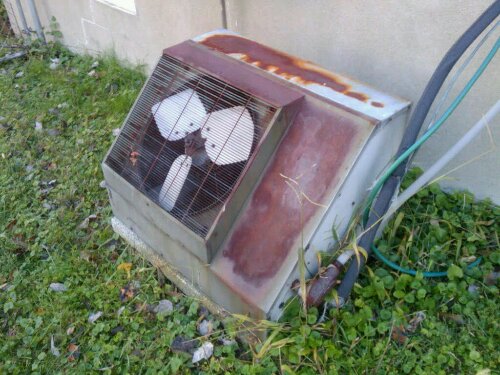
    If your heat pump looks like this, don’t be alarmed. It will clear itself in within the hour as it performs a defrost cycle. Why does frost form on your heat pump? How does this all work?

    A heat pump is nothing but an air conditioner with an extra couple of components – a reversing valve and a defrost control board. The typical air conditioner rejects heat into the outside air and extracts heat (cools the air) from inside your home. While it’s removing heat from your home, it is also removing moisture because the coil temperature is less than dew point of your home. The same thing is happening in the winter except it is extracting heat from the outdoor air. The surface temperature of your outdoor coil is cold enough that frost forms on the coil.
    Have you ever heard the loud ‘swoosh’ from your heat pump? That’s the sound of the reversing valve being energized for a defrost cycle. The outdoor coil is warmed and the frost melts from the coil. This happens every 30-120 minutes depending on your particular brand of heat pump. It’s always best to have the defrost cycle set to the longest interval possible. Some areas of the country have so much moisture in the air that they must defrost every thirty minutes.  This heat pump was running and maintaining a nice 70°F with no auxiliary heat.
    If the frost continues to build and you notice the AUX heat is energized continuously on your thermostat, then it’s best to call for service. No need for a surprise $400 utility bill!
    Call today 812-280-0510 VanKleef Heating and Air Conditioning, Inc. (Jeffersonville Indiana – Serving the Kentuckiana Area)

  • 3 Benefits Of Ductless Mini Splits

    If you’ve recently added some living space to your home by either remodeling or adding on, you’ll probably want to condition the air in order to use the space during the winter and summer. A ductless mini split heat pump is one of the easiest ways to add heat and cooling to a new space in your home, since these systems don’t use any air ducts to deliver air.
    Although the technology has been used abroad for years, it’ relatively new to the U.S. These systems are just like heat pumps, but instead of requiring a central air handler, the systems use separate units that blow directly into particular rooms or zones.
    Louisville furnaceThe major advantages of ductless mini splits include:
    Ease of installation – Unlike standard heat pumps, these systems require just a conduit to provide the power, refrigerant and drain lines to feed up to four indoor air handlers. The installer drills a three-inch hole through the exterior wall to run the conduit. The smaller systems can run off 120 volts, simplifying the wiring.
    Energy efficiency. Because no ducts are involved, no losses occur moving the air. Ducts can leak and lose heat or cold as the air travels through un-insulated ducts or spaces. Some mini split compressors can handle four separate air handlers for different spaces within your home, and each has a separate thermostat. When you’re not using a space, you can turn the handler off or set the temperature higher or lower, saving energy. Some of the mini split systems also use energy-efficient components, including variable-speed motors that use considerably less electricity to blow conditioned air than a single-speed motor.
    Design flexibility.The air handlers can sit on the floor or hang from ceilings and walls. Since most systems have remote controls, it’s easy to change the settings with the touch of a button from a distance.
    VanKleef Heating and Air Conditioning, Inc. 812-280-0510
  • HVAC Tax Credits and Rebates

    Have you been on the fence about purchasing a new heating and cooling system hoping the air conditioner makes it through the summer? Did your furnace fail at the end of the previous heating season? There are incentives to purchase a new HVAC system this year from Duke, Vectren and REMC.
    You can contact us and discuss with Werner VanKleef at 812-280-0510
    VanKleef Heating and Air Conditioning, Inc.

  • What’s inside your furnace?

    So that’s what is inside your furnace… It’s most likely a clam shell heat exchanger. This one happens to be cracked. The top center eyelet of each heat exchanger has a crack of above and below it. The others are nearing failure. However, one crack is all it takes to condemn.

    What’s wrong with a crack? In the modern furnace, the primary risks is a fire. Over time the crack will open and allow flames to hit the cabinet. The secondary risk is carbon monoxide poisoning. This scenario is less likely due to the pressure switches that monitor the negative pressure inside the heat exchanger. You’re more likely to get air from the blower inside the heat exchanger rather than flue gases escaping.
    How do you prevent this type of failure? It all goes back to proper air flow. Your ducts should provide design air flow per the manufacturer’s recommendations.
    Often, we find that the duct system needs to be modified to achieve desired air flow.
    Second, you must change your air filter regularly. Although some filters state ‘Three Months”, it’s important to check them monthly. You may find that your system draws more dust and animal hair than the filter can handle in three months.
    Finally, regular furnace maintenance by a professional service company keeps your system operating properly. You should have your HVAC system serviced twice a year — once for heating and the other time for air conditioning.
    Give us a call today for all of your heating and air conditioning needs in Southern Indiana or the Louisville area — VanKleef Heating and Air Conditioning, Inc. (812)280-0510.

  • I need some Freon again.

    Far too frequently, we receive the call from our  customers requesting more freon. Hmm. Not good. Air conditioning systems are sealed systems. They shouldn’t need a shot of ‘freon’ every year to keep it cooling.
    “What’s the big deal? Just fill ‘er up.” Well, it is a big deal when you look at all the problems caused by leaking HVAC systems.
    The first issues deal with detrimental effects on the system longevity.  Refrigerant (Freon, R-22, R-410a) circulates oil through the system. If you’re low on refrigerant, oil isn’t returned properly to the compressor.  Bearings don’t get lubricated. Compressor life is shortened. You pay more money.
    Refrigerant is also the cooling medium for the compressor.  Say what? Yes, really. The refrigerant passes across the compressor windings to keep it cooled. Compressor runs hot. Windings fail. You pay more money for a replacement compressor or a new system.
    The second issues deal with ineffective system performance. As the refrigerant leaks from your system, the indoor coil runs warmer and is unable to remove as much heat from the air. This makes the system have to run longer. Running longer results in higher utility bills. Eventually, the system won’t be able to remove enough heat to maintain set point, and you’ll be calling VanKleef Heating and Air Conditioning again.
    The other part of the performance issue is moisture removal. With a warmer coil, you are not sufficiently reducing the dew point of the air. With a higher dew point, more moisture remains in the air being returned to your rooms. Higher humidity levels in the home result in discomfort and you lowering the thermostat set point. The system runs even longer and you pay more money to the utility.
    So, before you call for that ‘shot of freon’ consider the long term effects on your wallet and comfort. The wise investment is to let VanKleef Heating and Air Conditioning find the leak and repair it.
    812-280-0510